
Retatrutide Dose

Dosing · Trial data · 14 trial arms

Retatrutide dosage: every trial dose, 1 to 12 mg

Every retatrutide dose with published human data, 1 to 12 mg a week, what it produced and how the trials escalated it.

11 min read9 sources
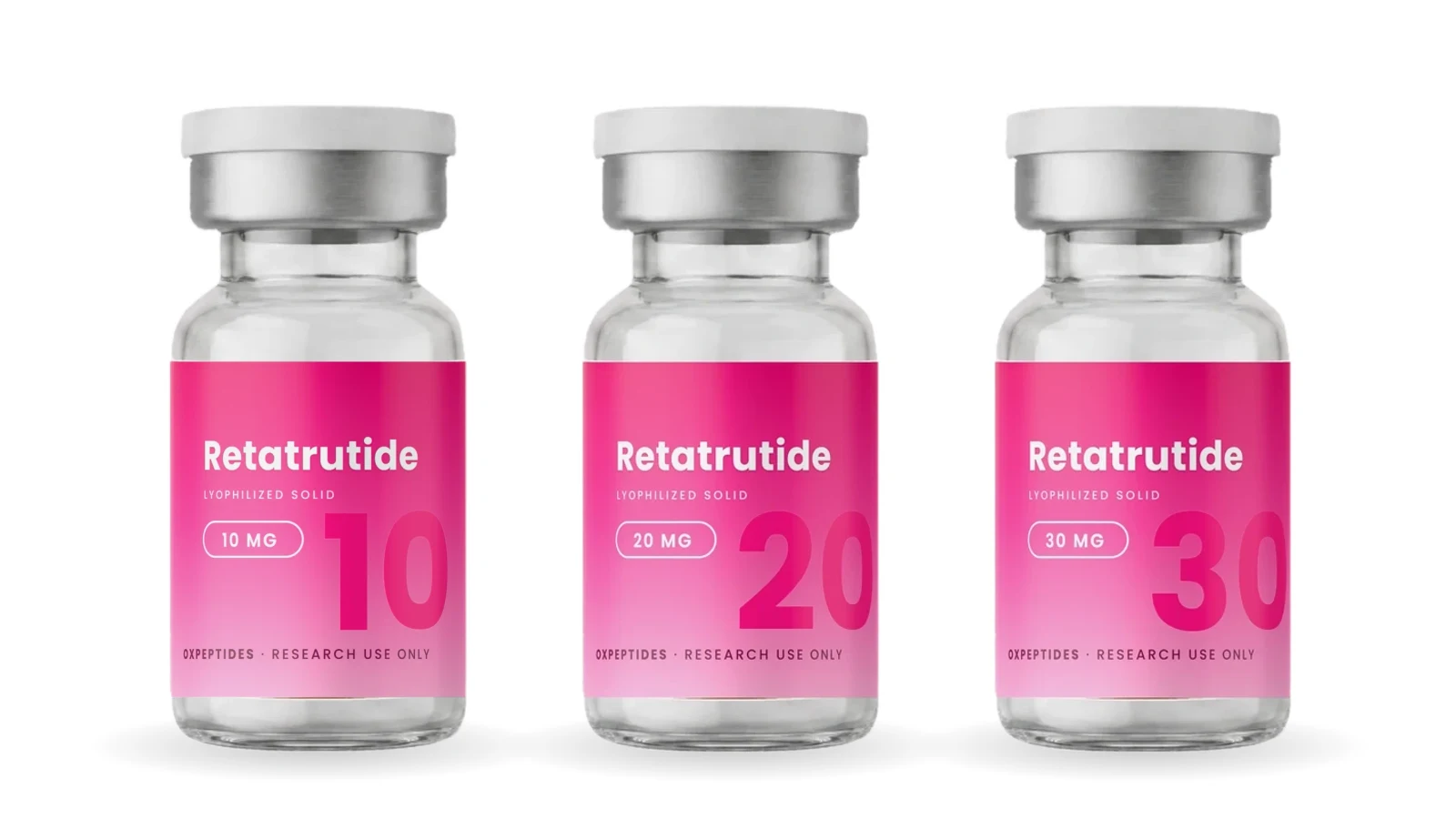
Three sealed OXpeptides Retatrutide research vials, crimp caps and white lyophilised cake, on a white background

Phase 2 obesity trial, primary and secondary endpoints

n = 338 adults

Dose ladder: body weight change at 48 weeks by weekly dose

-8.7%1 mgweek 48
-17.1%4 mgweek 48
-22.8%8 mgweek 48
-24.2%12 mgweek 48
one injection a week, escalated from 2 mg to the target dose by week 12
Figure 1. Least-squares mean change in body weight at week 48 by weekly maintenance dose, 338 adults with obesity, placebo -2.1 %. Vial fill is proportional to the dose. Source: Jastreboff et al., NEJM 2023

Escalation: every arm above 1 mg started at 2 mg and stepped up every 4 weeks; the 12 mg arm reached its dose by week 12.

Our pick

OXpeptides Retatrutide 10 mg vial, the real productOXpeptides
Retatrutide 10 mg, research grade
  • Registered company OX RESEARCH LTD, no. 17464288
  • Lot printed on every vial, tested by Janoshik (September 2026 lots)
  • Ships in 1-2 business days, tracked, reshipped if lost

$99

per 10 mg vial, research use only

See it at OXpeptides

Research use only. Not for human or veterinary use. Retatrutide is an investigational compound that has not been approved by the FDA or the EMA for any use. Nothing on this page is medical advice, dosing guidance or an offer to treat any condition. OXpeptides sells to qualified researchers under its terms.

How it works

Retatrutide (Eli Lilly code LY3437943) is a single peptide that activates three receptors at once: GIP, GLP-1 and glucagon. The glucagon component is what separates it from the single (GLP-1) and dual (GIP and GLP-1) agonists that came before it. In the phase 1b trial its half-life was approximately 6 days with dose-proportional exposure, which is why every trial gives it once a week.

The dose is the lever. In the 48-week phase 2 obesity trial, weight fell 8.7% at 1 mg and 24.2% at 12 mg; in the liver substudy, liver fat fell 42.9% at 1 mg and 82.4% at 12 mg at 24 weeks. What follows is every dose the trials used, what it produced, and how it was reached.

What the trials showed

The human dose range of retatrutide was mapped in three steps: a 12-week phase 1b multiple-ascending-dose study, two 36 to 48-week phase 2 trials, and a phase 3 program that began in 2023. The table lists every weekly maintenance dose that has been published with results, and the starting dose that led to it.

Two things stand out. First, no trial has gone above 12 mg a week, so 12 mg is the ceiling of the human evidence. Second, the phase 3 designers dropped 1 mg and 8 mg and inserted 9 mg, a choice the Lancet authors say was informed by the phase 2 dose-response data.

1 mg
Trial
Phase 2 obesity, NEJM 2023
Escalation
no escalation
Weeks
48
Reported result
-8.7% body weight
4 mg
Trial
Phase 2 obesity, NEJM 2023
Escalation
2 or 4 mg start
Weeks
48
Reported result
-17.1% body weight
8 mg
Trial
Phase 2 obesity, NEJM 2023
Escalation
2, 4 then 8 mg (or 4 then 8)
Weeks
48
Reported result
-22.8% body weight
12 mg
Trial
Phase 2 obesity, NEJM 2023
Escalation
2, 4, 8 then 12 mg by week 12
Weeks
48
Reported result
-24.2% body weight
Placebo
Trial
Phase 2 obesity, NEJM 2023
Escalation
none
Weeks
48
Reported result
-2.1% body weight
0.5 mg
Trial
Phase 2 type 2 diabetes, Lancet 2023
Escalation
fixed
Weeks
36
Reported result
HbA1c -0.43 pts; weight -3.19%
4 mg
Trial
Phase 2 type 2 diabetes, Lancet 2023
Escalation
2 mg start, or none
Weeks
36
Reported result
HbA1c -1.39 / -1.30 pts; weight -7.92% / -10.37%
8 mg
Trial
Phase 2 type 2 diabetes, Lancet 2023
Escalation
slow (2, 4, 8) or fast (4, 8)
Weeks
36
Reported result
HbA1c -1.99 / -1.88 pts; weight -16.81% / -16.34%
12 mg
Trial
Phase 2 type 2 diabetes, Lancet 2023
Escalation
2, 4, 8 then 12 mg
Weeks
36
Reported result
HbA1c -2.02 pts; weight -16.94%
4 mg
Trial
Phase 3 TRANSCEND-T2D-1, Lancet 2026
Escalation
per protocol
Weeks
40
Reported result
HbA1c -1.69 pts; weight -11.5%
9 mg
Trial
Phase 3 TRANSCEND-T2D-1, Lancet 2026
Escalation
per protocol
Weeks
40
Reported result
HbA1c -1.86 pts; weight -13.9%
12 mg
Trial
Phase 3 TRANSCEND-T2D-1, Lancet 2026
Escalation
per protocol
Weeks
40
Reported result
HbA1c -1.94 pts; weight -15.3%
4, 9, 12 mg
Trial
Phase 3 TRIUMPH-1 and 2 (registry)
Escalation
16-week fixed escalation
Weeks
80
Reported result
not yet published
9, 12 mg
Trial
Phase 3 TRIUMPH-3 and 4 (registry)
Escalation
16-week fixed escalation
Weeks
80
Reported result
not yet published (68 wk in TRIUMPH-4)

Table 1. Every retatrutide trial arm with a published human result, plus the completed phase 3 arms awaiting publication. Weight figures are least-squares mean changes at the end of treatment; HbA1c at 24 weeks (phase 2) or 40 weeks (phase 3). Sources: Jastreboff et al., NEJM 2023 (338 adults); Rosenstock et al., Lancet 2023 (281); Bajaj et al., Lancet 2026 (537); TRIUMPH registry entries. DOIs in the Sources section.

Weight change by dose: 8.7% at 1 mg, 24.2% at 12 mg

The clearest dose-response data comes from the NEJM phase 2 obesity trial. Participants had a BMI of 30 or higher, or 27 to 30 with a weight-related condition, and were followed for 48 weeks. The chart shows the least-squares mean percentage change in body weight at the primary endpoint (24 weeks) and at the end of treatment (48 weeks).

Figure 2

Retatrutide phase 2 obesity trial: mean percent change in body weight by weekly dose at 24 and 48 weeksBar chart. Placebo minus 1.6 percent at 24 weeks and minus 2.1 at 48 weeks. 1 mg minus 7.2 and minus 8.7. 4 mg minus 12.9 and minus 17.1. 8 mg minus 17.3 and minus 22.8. 12 mg minus 17.5 and minus 24.2. Source: Jastreboff et al., NEJM 2023, 338 adults with obesity.Body weight change by weekly dose (least-squares mean, %)0-5%-10%-15%-20%-25%-1.6%-2.1%Placebo-7.2%-8.7%1 mg-12.9%-17.1%4 mg-17.3%-22.8%8 mg-17.5%-24.2%12 mg24 weeks (primary endpoint)48 weeks
Figure 2. Phase 2 obesity trial, 338 adults, once-weekly subcutaneous retatrutide for 48 weeks; the 4 mg and 8 mg values pool the two starting-dose groups. Source: Jastreboff et al., NEJM 2023, DOI 10.1056/NEJMoa2301972.

In adults with obesity, retatrutide treatment for 48 weeks resulted in substantial reductions in body weight.

Jastreboff et al., NEJM 2023, phase 2 obesity trial, 338 adults

The curve flattens at the top. Going from 1 mg to 4 mg roughly doubled the effect, 4 mg to 8 mg added another 5.7 points, and 8 mg to 12 mg added 1.4 points. Weight was still falling at week 48 in the higher dose groups, which is one reason the phase 3 trials run to week 80.

How the protocols climbed: 2, 4, 8, 12

Every maintenance dose above 1 mg was reached by steps, not in one jump. In the phase 2 obesity trial the registry describes the 12 mg arm as "2 mg starting dose followed by 4 mg, 8 mg and then 12 mg", with escalation "up to Week 12".

That is three steps in twelve weeks, and the same 2 to 4 to 8 pattern was used for the 8 mg arm. Two arms were deliberately started at 4 mg instead of 2 mg to test whether the gentler start mattered; it did, for gastrointestinal tolerability, though not for the final weight result.

The phase 3 TRIUMPH trials use a "fixed dose escalation regimen" that takes 16 weeks, followed by 64 weeks of maintenance. The design paper does not print the intermediate steps, so this site does not guess them. Both programs allow a permanent dose reduction when gastrointestinal events or poor oral intake do not settle. The full week-by-week layout is in the dosing schedule guide, and the tolerability findings in the titration guide.

Figure 3

How the 12 mg arm was reached in the phase 2 obesity trial (NEJM 2023)2 mg from week 1 to week 4; 4 mg from week 5 to week 8; 8 mg from week 9 to week 12; 12 mg maintenance to week 48 from week 13 to week 48.How the 12 mg arm was reached in the phase 2 obesity trial (NEJM 2023)2 mg4 mg8 mg12 mg maintenance to week 48wk 04812162024283236404448Primary endpoint, week 24weeks of once-weekly injections
Figure 3. Registry description of the 12 mg arm: 2 mg start, then 4, 8 and 12 mg, escalation completed by week 12 (NCT04881760). Primary endpoint at week 24, end of treatment at week 48.

Why 12 mg is the number everyone quotes, and what it hides

By the numbers, 12 mg. It produced the largest mean weight change and the largest share of participants crossing each threshold: at 48 weeks, 100% lost at least 5%, 93% lost at least 10% and 83% lost at least 15% of their body weight. The 8 mg group was close behind at 100%, 91% and 75%.

Figure 4

Share of participants reaching 5, 10 and 15 percent weight reduction at 48 weeks, by retatrutide dosePlacebo: 27, 9 and 2 percent. 4 mg: 92, 75 and 60 percent. 8 mg: 100, 91 and 75 percent. 12 mg: 100, 93 and 83 percent. Source: Jastreboff et al., NEJM 2023.Participants reaching a weight-loss threshold at 48 weeks (%)Placebo27%9%2%4 mg92%75%60%8 mg100%91%75%12 mg100%93%83%at least 5%at least 10%at least 15%
Figure 4. Share of participants reaching 5, 10 and 15% weight reduction at 48 weeks, secondary endpoints of the phase 2 obesity trial. Source: Jastreboff et al., NEJM 2023.

Whether the extra 1.4 points from 8 to 12 mg is worth the dose-related increase in gastrointestinal events is exactly the question the phase 3 program was built to answer with larger numbers, which is why 9 mg sits between them in TRIUMPH.

In the liver substudy, 8 mg and 12 mg were almost identical (liver fat down 81.4% and 82.4% at 24 weeks), and in the type 2 diabetes trial the 8 mg and 12 mg HbA1c results were within 0.03 points of each other. All of those figures, by dose and by trial, are collected in the results page.

No standard dose, but one consensus: 4, 9 and 12 mg

No. Retatrutide has no marketing authorisation, so there is no label and no approved dose. The closest thing to a consensus is the phase 3 choice of 4, 9 and 12 mg once weekly, because that is what Lilly and its investigators considered worth testing in more than 5,800 people.

The first phase 3 publication, the 40-week TRANSCEND-T2D-1 trial in the Lancet in June 2026, reported mean weight changes of -11.5% at 4 mg, -13.9% at 9 mg and -15.3% at 12 mg in adults with type 2 diabetes, alongside HbA1c reductions of 1.69 to 1.94 percentage points.

Any text that presents a "protocol" outside these ranges, or a dose adjusted to body weight, is not drawn from the trials: none of the published studies dosed by weight, and none went below 0.5 mg or above 12 mg.

Retatrutide dosage in type 2 diabetes

The diabetes trials used the same ladder with one extra rung at the bottom: 0.5 mg. In the 2023 Lancet phase 2 trial, HbA1c at 24 weeks fell by 0.43 points at 0.5 mg, 1.30 to 1.39 at 4 mg, 1.88 to 1.99 at 8 mg and 2.02 at 12 mg, versus 0.01 with placebo and 1.41 with dulaglutide 1.5 mg.

Body weight at 36 weeks fell 3.19% at 0.5 mg and 16.94% at 12 mg. The dose-by-dose detail, including the 2026 phase 3 numbers, is in the type 2 diabetes dose guide.

A vial label is not a dose

Research suppliers sell retatrutide as lyophilised powder in vials labelled 5 mg, 10 mg or 20 mg. That number is the total peptide in the vial, not a weekly dose. A 10 mg vial reconstituted with 2 mL of diluent gives 5 mg/mL, so 4 mg (a phase 3 dose) occupies 0.8 mL and 12 mg would need more than one vial.

The arithmetic, with a calculator, is in the reconstitution guide, and the mapping of vial sizes to trial doses in the vial-size guide. Suppliers who publish a certificate of analysis per batch make it possible to check that the label matches the contents; one such listing is at See it at OXpeptides (research use only).

Side effects

The NEJM paper describes the adverse events in one sentence worth quoting in substance: the most common events were gastrointestinal, they were dose-related, mostly mild to moderate, and partially mitigated by the 2 mg starting dose compared with 4 mg. Heart rate increased in a dose-dependent way, peaked at 24 weeks and declined afterwards.

The side-effect profile by dose, including the heart-rate data, is the subject of the sister site retatrutiderisk.com, in particular its side-effects article.

Approval status

Retatrutide is an investigational compound. It has not been approved by the FDA, the EMA or any other regulator for any use, so there is no label and no approved dose. The phase 3 program (TRIUMPH-1 to 4, TRANSCEND-T2D) tests 4, 9 and 12 mg once weekly in more than 5,800 people; the first phase 3 paper, TRANSCEND-T2D-1, was published in The Lancet in 2026 and the obesity trials are registered with primary endpoints at week 80.


Where to get it

13 vendors, ranked on 11 points (8 checks), every site opened on 21 Sep 2026. The grid is what a buyer can verify before paying: company number, lot on the vial, purity spec per lot, tracked shipping with reship, 3-D Secure card, US and EU, clear research-use wording. Nothing ordered, nothing reviewed.

TierVendorPriceScore / 11
S
OXpeptidesOXpeptidesOX RESEARCH LTD no. 17464288 · Janoshik, Sept 2026 lots
$9910 mg11/11
A
Amino ClubILS Laboratories per lot; no card or company number shown
$45.4910 mg5/11
Northline LabsLab not named; testimonials on a research listing
$79.9910 mg4/11
American PeptidesLab not named; no company number or card shown
$10510 mg4/11
Glow PeptidesCard shown; retatrutide listing unreachable on 21 Sep
4/11
B
Protide HealthLab named on certificate only; Trustpilot removed
3/11
Swiss ChemsNo retatrutide listing; sells SARMs and capsules
2/11
C
PeptiraCertificates behind registration; Trustpilot removed
1/11
Simple PeptideCatalog, prices, certificates behind registration
1/11
Apex PeptidesLogin wall: nothing verifiable before registering
0/11
Ion PeptideIon PeptideCould not be read on 21 Sep (blocks automated access)
0/11
Modern AminosCould not be read on 21 Sep (blocks automated access)
0/11
PureRawzNo retatrutide; weight-loss claims, affiliate links
0/11

S = every check passed (9-11 / 11) · A = most checks passed (4-8 / 11) · B = several checks failed (2-3 / 11) · C = could not be verified (0-1 / 11)

Research use only. Not for human or veterinary use. Retatrutide is an investigational compound that has not been approved by the FDA or the EMA for any use. Nothing on this page is medical advice, dosing guidance or an offer to treat any condition. OXpeptides sells to qualified researchers under its terms.

The full evidence, vendor by vendor, is on the where-to-get page.

Asked and answered

What is the retatrutide dosage used in clinical trials?

The phase 2 obesity trial (NEJM 2023) randomised 338 adults to 1, 4, 8 or 12 mg once weekly for 48 weeks. The phase 2 type 2 diabetes trial (Lancet 2023) used 0.5, 4, 8 and 12 mg for 36 weeks. The phase 3 TRIUMPH trials use 4, 9 and 12 mg, and TRANSCEND-T2D-1 used 4, 9 and 12 mg for 40 weeks.

What was the retatrutide starting dose in the trials?

In the phase 2 trials most groups started at 2 mg once weekly and were escalated in steps. Two groups started directly at 4 mg so that the effect of the starting dose could be measured: the lower 2 mg start partially mitigated gastrointestinal adverse events.

Which retatrutide dose produced the most weight loss?

12 mg once weekly, with a least-squares mean change of -24.2% at 48 weeks in the phase 2 obesity trial. The 8 mg group reached -22.8%, so the step from 8 to 12 mg added 1.4 percentage points.

Is there an approved retatrutide dose?

No. Retatrutide has not been approved by the FDA or the EMA, so there is no labelled dose. The only doses with published human data are the trial doses listed on this page.

How often was retatrutide dosed?

Once a week, by subcutaneous injection, in every published trial. The half-life of approximately 6 days measured in the phase 1b study is what makes weekly dosing workable.

Sources

Sources

  1. [1]

    New England Journal of Medicine · 2023

    Triple-Hormone-Receptor Agonist Retatrutide for Obesity: A Phase 2 Trial

    Jastreboff AM, Kaplan LM, Frias JP, et al

    doi:10.1056/NEJMoa2301972
  2. [2]

    The Lancet · 2023

    Retatrutide, a GIP, GLP-1 and glucagon receptor agonist, for people with type 2 diabetes: a randomised, double-blind, placebo and active-controlled, parallel-group, phase 2 trial conducted in the USA

    Rosenstock J, Frias J, Jastreboff AM, et al

    doi:10.1016/S0140-6736(23)01053-X
  3. [3]

    The Lancet · 2026

    Efficacy and safety of retatrutide, a GIP, GLP-1, and glucagon receptor agonist, in people with type 2 diabetes and inadequate glycaemic control with diet and exercise (TRANSCEND-T2D-1): a double-blind, randomised, phase 3 trial

    Bajaj HS, Welch M, Shah P, et al

    doi:10.1016/S0140-6736(26)00967-0
  4. [4]

    Diabetes, Obesity and Metabolism · 2025

    Retatrutide for the treatment of obesity, obstructive sleep apnea and knee osteoarthritis: Rationale and design of the TRIUMPH registrational clinical trials

    Giblin A, et al

    doi:10.1111/dom.70209
  5. [5]

    The Lancet · 2022

    LY3437943, a novel triple GIP, GLP-1, and glucagon receptor agonist in people with type 2 diabetes: a phase 1b, multicentre, double-blind, placebo-controlled, randomised, multiple-ascending dose trial

    Urva S, Coskun T, Loh MT, et al

    doi:10.1016/S0140-6736(22)02033-5
  6. [6]

    Nature Medicine · 2024

    Triple hormone receptor agonist retatrutide for metabolic dysfunction-associated steatotic liver disease: a randomized phase 2a trial

    Sanyal AJ, Kaplan LM, Frias JP, et al

    doi:10.1038/s41591-024-03018-2
  7. [7]

    ClinicalTrials.gov · 2026

    A Phase 2 Study of Once-Weekly LY3437943 Compared With Placebo in Participants Who Have Obesity or Are Overweight

    ClinicalTrials.gov

    https://clinicaltrials.gov/study/NCT04881760
  8. [8]

    ClinicalTrials.gov · 2026

    A Phase 2 Study of Once-Weekly LY3437943 Compared With Placebo and Dulaglutide in Participants With Type 2 Diabetes

    ClinicalTrials.gov

    https://clinicaltrials.gov/study/NCT04867785
  9. [9]

    ClinicalTrials.gov · 2026

    TRIUMPH-1: retatrutide once weekly in participants without type 2 diabetes who have obesity or overweight

    ClinicalTrials.gov

    https://clinicaltrials.gov/study/NCT05929066